Gift card
Physical vs E-Code Gift Cards in Nigeria: Which Pays More?
Nov 21, 2026
•
3 mins read
Physical vs e-code gift cards can have different resale values in Nigeria, even when they carry the same brand and dollar value.
Imagine two people who each have a $100 gift card. One has a physical gift card purchased from a store, while the other has an e-code received by email. Both cards are valid, and both have the same value. But when they decide to sell, will they receive the same amount? Not necessarily. Factors such as the gift card brand, country, denomination, demand, and verification requirements can affect how much buyers are willing to pay.
So, which pays more in Nigeria: physical or e-code gift cards? Does having the physical card give you an advantage, or can an e-code offer just as much value? In this guide, we'll compare both types, explain what affects their exchange rates, and show you what to consider before buying or selling either one.
Understanding the Different Forms of Gift Cards
Before comparing their rates, it is important to understand what physical and e-code gift cards are. Although they serve a similar purpose, they come in different forms and have different ways of being delivered and used.
What Are Physical Gift Cards?
A physical gift card is a plastic card that you can hold in your hand. It usually comes in a package and has a printed design, barcode, or other identifying details. Depending on the brand, it may also have a scratch-off section that hides the redemption code.
You can buy physical gift cards from selected retail stores, supermarkets, or other authorised sellers. They are often purchased as gifts because they can be placed inside a card or gift package and handed directly to someone.
Examples include physical gift cards from Amazon, Apple, Google Play, and other popular brands.
When selling a physical gift card, you may be asked to provide clear pictures of the front and back of the card. You may also need to provide a receipt or other proof of purchase, depending on the buyer's requirements.
What Are E-Code Gift Cards?
An e-code gift card is a digital gift card delivered electronically. Instead of receiving a plastic card, you receive the gift card details through email, a website, an app, or another digital channel.
The details usually include a redemption code and, in some cases, a PIN or instructions on how to use the card.
E-codes are popular because they are easy to send and receive. You do not need to carry a physical card or wait for it to be delivered. Once you receive the code, you can access the details from your phone or computer.
For example, if someone purchases an Amazon gift card online and receives the code in their email, that is an e-code gift card.
Open-Loop vs Closed-Loop Gift Cards
You may also come across the terms open-loop and closed-loop when learning about gift cards. These terms describe where and how a gift card can be used.
An open-loop gift card is usually connected to a payment network, such as Visa or Mastercard. Depending on its terms, it can be used at different merchants that accept that payment network.
A closed-loop gift card is issued for use with a particular brand, store, or group of related businesses. For example, an Amazon gift card is designed for use on Amazon, while an Apple gift card is intended for eligible Apple purchases and services.
This distinction is important because not every gift card works the same way. Before buying or selling one, check the brand's terms and the countries or stores where it can be redeemed.
Physical vs E-Code Gift Cards: Key Differences
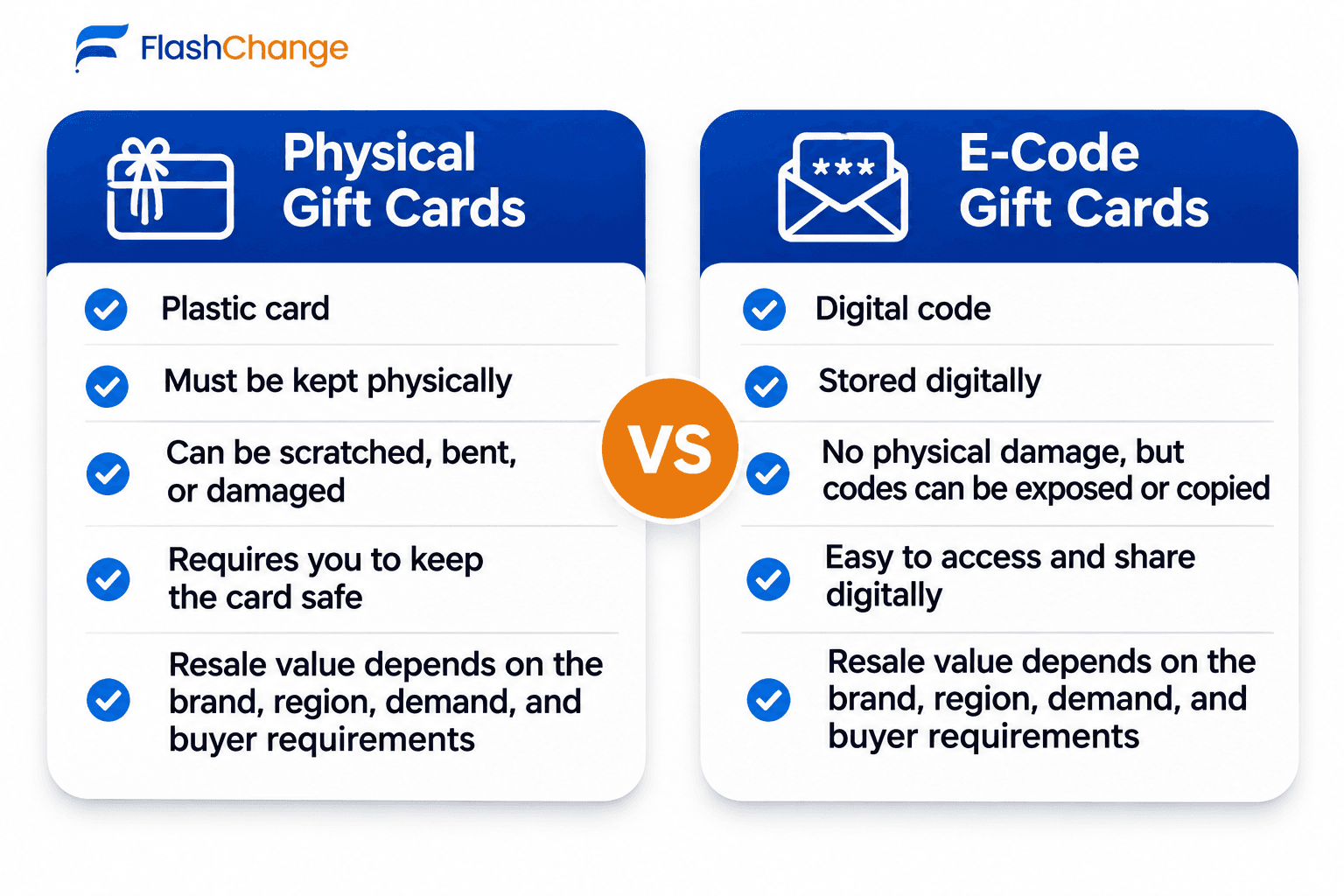
The main difference between physical and e-code gift cards is how they are issued and delivered. However, there are other things to consider, especially when you plan to sell them in Nigeria.
| Feature | Physical Gift Cards | E-Code Gift Cards |
|---|---|---|
| Format | Plastic card | Digital code |
| Delivery | Usually purchased or received in person | Delivered electronically |
| Storage | Must be kept physically | Stored digitally |
| Proof of purchase | A receipt may be requested | Purchase confirmation or email may be requested |
| Verification | May require clear pictures of the card and code | May require the original code and purchase details |
| Risk of damage | Can be scratched, bent, or damaged | No physical damage, but codes can be exposed or copied |
| Convenience | Requires you to keep the card safe | Easy to access and share digitally |
| Resale value | Depends on the brand, region, demand, and buyer requirements | Depends on the brand, region, demand, and buyer requirement |
Neither format is automatically better in every situation. A physical card may have an advantage when buyers prefer cards with clear proof of purchase, while an e-code may be more convenient when digital codes are accepted and easy to verify.
The actual exchange rate depends on the card and the buyer's requirements.
Which Pays More in Nigeria: Physical or E-Code Gift Cards?
This is the question most people want answered. If you have a physical gift card and someone else has an e-code with the same value, who is likely to receive more money?
The honest answer is that physical gift cards may sometimes pay more than e-codes, but this is not a fixed rule.
Some buyers may prefer physical cards because they can inspect the card, check its details, and request a receipt. In other cases, e-codes may attract competitive rates because they are easier to submit and do not require physical handling.
The brand, country, denomination, demand, and verification requirements can make a bigger difference than the format alone.
Why Physical Gift Cards May Pay More
There are situations where physical gift cards may attract better rates.
One reason is proof of purchase. Some buyers prefer physical cards that come with a valid receipt because it can help them confirm where the card was purchased and provide additional information during verification.
The card's condition can also matter. A physical card with a clear, readable code and no signs of damage may be easier to assess than one that has been scratched incorrectly or damaged.
Some buyers may also have stronger demand for particular physical gift cards. When that happens, the card may receive a more attractive rate.
However, having a physical card does not automatically mean you will receive more money. The card must still be valid, unused, and accepted by the buyer.
Why E-Code Gift Cards May Pay Less
Some e-codes may receive lower rates because of the risks associated with digital codes.
For example, a code can be copied, shared, or redeemed before the buyer completes verification. Once a gift card code has been exposed, it may be difficult to establish who used it if something goes wrong.
There may also be questions about the source of the code. A buyer may want to confirm that it came from a legitimate purchase and has not already been redeemed.
These concerns can affect the rate offered for certain e-codes.
However, this does not mean all e-codes pay less. Some digital gift cards are in high demand and may offer rates that are similar to, or even higher than, their physical versions.
Can an E-Code Gift Card Ever Pay More Than a Physical Card?
Yes. An e-code gift card can sometimes pay more than a physical gift card.
Imagine that a buyer currently has a higher demand for a particular brand's digital codes. The e-code may attract a better rate, even if another person has the physical version of the same card.
The country and denomination can also affect the outcome. A $100 e-code from one region may have a different exchange rate from a $100 physical card from another region.
This is why it is important to compare the actual rates before selling. Do not assume that one format will always give you more money.
What Determines Physical and E-Code Gift Card Exchange Rates in Nigeria?
Several factors influence how much you can receive when selling a gift card. Understanding them can help you make better decisions and avoid accepting a lower rate without knowing why.
1. Gift Card Brand and Buyer Demand
The brand is one of the most important factors that can affect a gift card's exchange rate.
Some brands have stronger demand in the resale market than others. For example, buyers may be more interested in certain popular gift cards because they are easier to resell or have more uses.
However, demand can change. A brand that offers a good rate today may have a different rate tomorrow.
This is why you should check the current rate for your specific card instead of relying on what someone else received in the past.
2. Card Country and Region
Gift cards are often issued for specific countries or regions. A card purchased in the United States may not have the same resale value as one purchased in the United Kingdom or another country.
This is because redemption restrictions, regional terms, and buyer demand can differ.
For example, two Amazon gift cards may have the same dollar-equivalent value but belong to different regional stores. Their exchange rates may not be the same.
Always confirm the country or region of your gift card before submitting it for sale.
3. Gift Card Denomination
The denomination is the amount loaded onto a gift card.
Gift cards come in different values, such as $25, $50, $100, and $200. The amount on the card can influence its resale rate, depending on the brand and buyer demand.
A higher denomination does not automatically guarantee a better rate. Some buyers may prefer certain values, while others may have different requirements.
Before selling, check the rate for your exact denomination.
4. Activation, Receipts and Proof of Purchase
A gift card must be properly activated before it can be used. If a physical card has not been activated at the point of purchase, it may not work.
Receipts can also be important. Some buyers request proof of purchase to help confirm the card's source and support their verification process.
For e-codes, an original purchase email or order confirmation may provide useful information.
Keep your receipts and purchase records where possible. They may help answer questions during the selling process.
5. Card Validity and Verification Risk
A gift card must be valid and unused before it can be sold.
If a code has already been redeemed, is invalid, or has been exposed to someone else, it may not be accepted.
This is especially important for e-codes. Avoid sharing your code with people or platforms you have not verified. Once another person has access to the code, you may lose control over it.
For physical cards, make sure the card is not damaged and that the required details can be read clearly.
6. Market Conditions and Trading Platform
Gift card rates are not permanent. They can change based on demand, availability, market conditions, and the buyers operating on a platform.
Different trading platforms may also offer different rates for the same gift card.
This means you should not assume that a rate you saw on one platform will be available everywhere. Compare the current offer, understand the platform's requirements, and check how much you will actually receive.
Physical vs E-Code Gift Cards: Which Is Better to Sell?
Choosing between physical and e-code gift cards depends on what you have, the card's details, and the options available to you.
Both formats can be worth selling, but each has its own advantages and things to watch out for.
When Physical Gift Cards Are a Better Option
A physical gift card may be a good option if:
- You have the original card and can provide clear pictures when requested.
- You have a purchase receipt or other proof of purchase.
- The card is in good condition and has not been damaged.
- The buyer accepts that particular physical card.
- The current rate is attractive compared with other available offers.
Physical cards can be useful for people who prefer having a tangible card and keeping the purchase details together.
However, always check the buyer's requirements before submitting the card.
When E-Code Gift Cards Make More Sense
An e-code may be more convenient if:
- You received the gift card through email or an online purchase.
- You want to avoid keeping or transporting a physical card.
- The buyer accepts that particular digital gift card.
- You can provide the original code and any required purchase information.
- The available rate is competitive.
E-codes are also easier to access because you can retrieve them from your email or digital account.
Just remember that convenience does not remove the need to protect your code. Do not send it to an unverified buyer or expose it unnecessarily.
How to Get the Best Value When Buying or Selling Gift Cards
Getting a good exchange rate is not only about choosing between a physical card and an e-code. You also need to know what to check before buying or selling.
What to Consider Before Buying Gift Cards for Resale
If you plan to buy gift cards and resell them later, take time to check the following:
1. Check the current exchange rate. Find out how much the gift card is worth in the resale market before buying it. Do not assume that every card will sell at a profitable rate.
2. Confirm the country and denomination. Make sure you know the card's region and value. These details can affect its resale options.
3. Understand the buyer's requirements. Some buyers accept physical cards, while others accept e-codes or both. Check the requirements before spending money.
4. Buy from a reliable source. Avoid purchasing gift cards from people or sellers who cannot provide reasonable proof that the cards are legitimate.
5. Calculate your expected return. Consider the purchase price, exchange rate, and any applicable fees. A card that looks like a good deal may not be profitable after all costs are considered.
What to Check Before Selling Your Gift Card
Before submitting your gift card, make sure you have checked these details:
- Brand: Confirm the exact gift card brand.
- Country: Know the region where the card was issued.
- Denomination: Confirm the amount loaded onto the card.
- Format: Know whether you have a physical card or an e-code.
- Validity: Make sure the card has not been redeemed or used.
- Proof of purchase: Keep the receipt or purchase confirmation if available.
- Current rate: Check the rate before making your decision.
These simple checks can help reduce mistakes and make the selling process easier.
How to Sell Physical and E-Code Gift Cards in Nigeria
The process of selling a gift card depends on the platform you choose. However, there are some general steps you can follow.
How to Sell a Physical Gift Card
If you have a physical gift card, here are some things to do:
- Identify the gift card. Confirm its brand, country, and denomination.
- Check its condition. Make sure the card is not damaged and that its details are readable.
- Keep your receipt. If you have the original purchase receipt, keep it available in case the buyer requests it.
- Check the current rate. Confirm how much the card is worth before submitting it.
- Follow the platform's instructions. Provide the required card details and images through the platform's approved process.
Do not scratch off or expose a hidden code unless the platform's instructions require you to do so.
How to Sell an E-Code Gift Card
Selling an e-code is also straightforward when you use a platform that accepts the card.
- Confirm the card details. Check the brand, country, and denomination.
- Locate the original code. Find the code in the email, purchase confirmation, or digital account where it was delivered.
- Check the current rate. Make sure you know the amount you can receive before proceeding.
- Use an accepted platform. Confirm that the platform supports your specific e-code.
- Submit the required details securely. Follow the platform's instructions and avoid sharing your code outside the approved process.
Always make sure you are using the correct platform and submission process. Never send your gift card code to a stranger who contacts you privately.
Common Gift Card Selling Mistakes to Avoid
Selling gift cards can be simple, but small mistakes can lead to delays, rejected submissions, or loss of value. Here are some common mistakes to avoid:
1. Selling without checking the rate
Gift card rates can change. If you rely on an old rate, you may expect to receive more money than the current offer provides. Always check the rate before selling.
2. Confusing gift card regions
A gift card's brand alone is not enough to identify it. A card issued for one country may have different terms and resale value from a card issued for another country.
3. Sharing your code with unverified buyers
This is one of the biggest risks when selling e-codes. Once someone has your code, they may be able to redeem it. Only submit your details through a platform's approved process.
4. Ignoring the card's denomination
A rate for a $100 card may not apply to a $25 or $50 card. Confirm the exact value before making a decision.
5. Assuming physical cards always pay more
Physical gift cards may sometimes attract better rates, but this is not guaranteed. An e-code may offer a better rate depending on the brand, region, and demand.
6. Failing to keep proof of purchase
Receipts and purchase confirmations can be useful during verification. Keep them safe, especially when buying gift cards for resale.
7. Choosing a platform without checking its requirements
Not every platform accepts every brand or format. Check what is supported and understand the submission requirements before sending your card details.
Is It Better to Sell Your Gift Card or Redeem It?
Sometimes, selling a gift card is the better choice. In other situations, redeeming it may give you more value.
The right decision depends on what you want to use the card for and how much you can receive from selling it.
If you regularly shop with the brand that issued the gift card, redeeming it may make sense. For example, an Amazon gift card may be useful if you already plan to purchase eligible products on Amazon.
However, if you do not need anything from the brand or would rather have the money in Naira, selling the gift card may be more practical.
Before deciding, compare the value you would get from using the card with the amount you would receive from selling it. Also consider any restrictions that apply to the gift card.
The goal is to choose the option that gives you the most useful value.
Where to Sell Physical and E-Code Gift Cards in Nigeria
If you want to sell a physical or e-code gift card in Nigeria, choose a platform that supports your specific card and provides clear information about its selling process.
Before using any gift card trading platform, check its accepted brands, supported regions, current rates, and submission requirements. You should also understand how the platform handles verification and payment.
Avoid platforms or individuals who ask you to share your gift card details through unofficial channels.
How to Sell Your Gift Cards on FlashChange
FlashChange provides a gift card trading option for people who want to exchange supported gift cards.
If you are considering selling your physical or e-code gift card, start by checking whether your specific card is supported and reviewing the current rate.
Make sure you select the correct brand, country, denomination, and card format when following the available selling instructions. Providing accurate details helps avoid confusion during the process.
You should also review the platform's instructions before submitting your card. Do not share your gift card code with anyone outside the approved process.
Visit FlashChange to check the available gift card options and find out more about selling your gift cards.
Frequently Asked Questions
1. Which pays more between physical and e-code gift cards in Nigeria?
There is no fixed answer. Physical gift cards may sometimes attract higher rates, but e-codes can also offer competitive rates. The final amount depends on the brand, country, denomination, buyer demand, and verification requirements.
2. What is the difference between physical and digital gift cards?
A physical gift card is a plastic card that you can hold, while a digital gift card or e-code is delivered electronically. Both can carry stored value, but they have different delivery methods and submission requirements when selling.
3. Do physical gift cards need to be activated before selling?
Yes, a physical gift card generally needs to be properly activated at the point of purchase before it can be used. An unactivated card may not work, so confirm its status before attempting to sell it.
4. Do I need a receipt to sell a physical gift card?
It depends on the buyer or platform. Some may request a receipt or proof of purchase to support verification, while others may have different requirements. It is best to keep your receipt if you have one.
5. Can I sell an e-code gift card in Nigeria?
Yes, you can sell an e-code in Nigeria through a platform that accepts that particular brand, region, and denomination. Always check the platform's requirements before submitting your code.
6. Can an e-code gift card have the same rate as a physical card?
Yes. An e-code and a physical gift card can have the same rate, depending on the brand, country, denomination, and market demand. In some cases, the e-code may even attract a higher rate.
7. Can I convert a physical gift card into an e-code?
Not in every case. Whether a physical gift card can be converted into a digital code depends on the brand and its policies. Some brands may offer digital delivery options, but you should not assume that an existing physical card can be exchanged for an e-code.
8. How can I get the best rate when selling my gift card?
Start by confirming the card's brand, country, denomination, and format. Then check the current exchange rate on a platform that supports your card. Keep your purchase records where possible and follow the platform's submission instructions carefully.
Conclusion
When comparing physical vs e-code gift cards, the format is only one part of the decision. A physical card may sometimes attract a better rate, but that does not mean it will always pay more than an e-code.
The brand, country, denomination, demand, card validity, and buyer requirements all play a role in determining how much you can receive.
Before selling, check the current rate for your exact gift card and compare the available options. Most importantly, use a platform you can verify and follow its approved submission process.
Whether you have a physical gift card or an e-code, understanding what affects its value can help you make a better selling decision.
Related articles
Gift card
Gaming Gift Card Rates in Nigeria: Steam, Razer Gold, Xbox & PSN
No excerpt available
Alale Emmanuel
Nov 21, 2026
•
3 min read
Gift card
Best Gift Cards for Gaming:Steam, Razer Gold, Roblox, PSN or Xbox?
Compare the best gaming gift cards, including Steam, Razer Gold, Roblox, PSN and Xbox. Learn their uses and how to choose the right card.
Alale Emmanuel
Oct 23, 2026
•
3 min read
Gift card
How Much Is a Razer Gold Gift Card in Naira? (Complete 2026 Guide)
Find out the Razer Gold gift card rates in Nigeria for 2026, learn their value in naira, and see how to sell your cards securely
Alale Emmanuel
Oct 23, 2026
•
3 min read
Subscribe to our Newsletter
Enter your contact details to get the latest news and trends to help boost your business.