Crypto
Can Nigeria Become Africa's Crypto Hub? What the Data Says
Sep 11, 2026
•
3 mins read
Nigerians already use crypto more than almost anyone else. Nigeria has ranked among the world's top countries for cryptocurrency adoption for several years running. That hasn't settled the more interesting question hanging over the industry: does using something the most also mean you're building the strongest ecosystem around it?
The honest answer is no, not automatically. Places that become genuine industry hubs, in film, technology or finance, rarely got there because their citizens consumed the most. They got there because they built systems strong enough to attract everyone else's activity too.
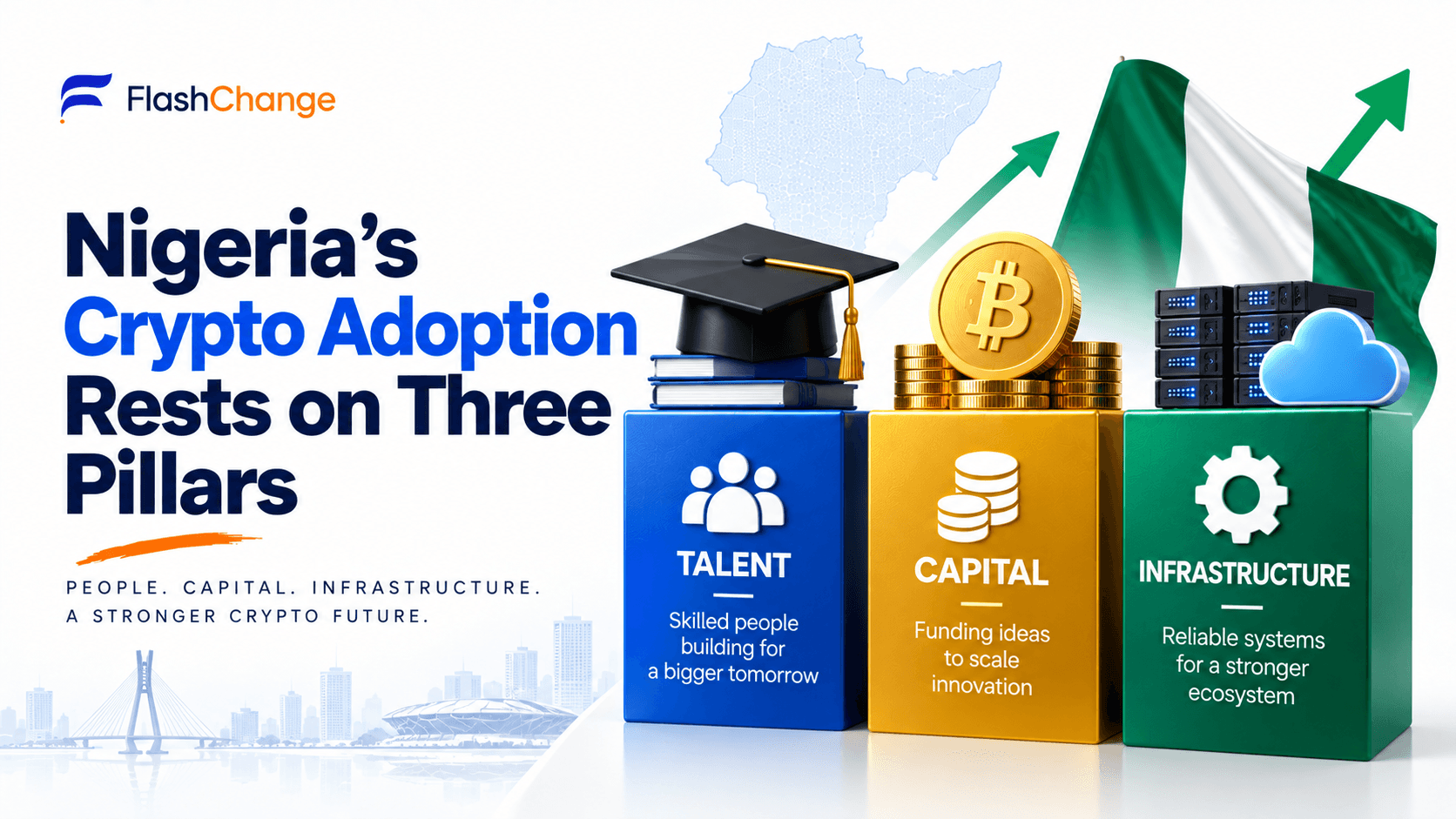
This piece looks at Nigeria's case through four pillars: talent, capital, regulation and infrastructure. It uses what the data from 2025 and 2026 actually shows, not what the adoption headlines imply.
What Actually Makes a Country a Crypto Hub?
Industry hubs don't form around whoever uses a technology most. They form around whoever builds the ecosystem that lets that technology scale for everyone, not just locally.
Film didn't concentrate in Los Angeles because Americans watched more movies than anyone else. Technology didn't concentrate in the Bay Area because Californians bought more computers. Finance didn't concentrate in London because the British loved banking more than everyone else.
In each case, a handful of ingredients came together: skilled people, available capital, workable rules, and infrastructure solid enough to build on. Crypto looks set to follow the same pattern.
FlashChange CEO Bidemi Oke has argued this directly. Turning Nigeria's crypto activity into durable industry leadership depends on four things working together at once: talent, capital, regulation and infrastructure. Not on any single one of them, and certainly not on adoption numbers alone.
Most countries manage to build strength in one or two of these areas. Very few manage all four. That's the real test, and it's worth checking where Nigeria actually stands on each one.
Nigeria's Adoption Story Is Real, and Also Not the Whole Story
Start with the numbers that get cited most often, because they're genuinely impressive. Chainalysis's 2025 Geography of Cryptocurrency report puts Nigeria's on-chain transaction value at $92.1 billion between July 2024 and June 2025. That's the highest in Sub-Saharan Africa by a wide margin, nearly three times South Africa's total, the region's second-largest market.
Ethiopia, Kenya and Ghana round out the top five, well behind both.
Nigerians also lean harder into Bitcoin specifically than most of the world does. Bitcoin accounted for 89% of fiat-to-crypto purchases in Nigeria, compared with a global average closer to 51%.
Persistent naira volatility and limited access to foreign currency both look like drivers here. Crypto, and increasingly stablecoins, function as a practical workaround rather than a speculative bet.
That's a real signal of demand. It is not, on its own, a signal of ecosystem strength. Consumption tells you people need something. It doesn't tell you whether the systems exist to build a durable industry around that need. For that, the other three pillars matter more.
Talent: Nigeria's Clearest Advantage
Of the four pillars, talent is the one where Nigeria's case is least contested. Nigerian engineers, product designers and blockchain developers are already building for a market well beyond Nigeria's borders.
Their products serve users across the continent, and in some cases, globally.
The wider tech numbers back this up. Nigeria is home to six of Africa's tech unicorns. Within its own startup landscape, crypto and Web3 rank as the second-largest category by number of active products, behind only fintech.
Talent alone doesn't build a hub. But it's the ingredient that's hardest to manufacture from scratch, and Nigeria isn't starting from zero on it. The harder questions live in the next three pillars.
Capital: Where the Adoption Story Breaks Down
This is where the picture gets more complicated, and more interesting. Despite leading the region in on-chain activity, Nigeria isn't the top destination for blockchain venture capital in Africa. That position belongs to South Africa.
According to CV VC and Absa's 2025 African Blockchain Report, companies headquartered in South Africa captured 19.4% of the continent's blockchain VC funding in 2025, roughly $17.5 million across seven deals.
Nigeria came second at 13.8%, about $12.4 million, spread across six deals. Kenya followed close behind at $12.9 million.
Nigeria did see real momentum within its own borders. A separate report from venture firm Hashed Emergent found Nigerian Web3 startups raised $43 million in 2025, more than double 2024's $20 million.
But that growth was narrow rather than broad. Stablecoin-linked finance products accounted for roughly $38 million of it, about 89% of the total, a five-fold jump from the year before.
Investors are backing one specific use case, digital dollar alternatives for payments and savings, far more than they're backing the rest of the ecosystem.
There's also a wider headwind worth naming. Blockchain venture funding across Africa as a whole fell 26.6% in 2025.
Capital isn't just choosing between countries. It's being more selective everywhere. US-headquartered companies still captured over a third of total funding value while accounting for barely a tenth of the deals.
So the honest read: Nigeria has real capital flowing in, but it's smaller than South Africa's, concentrated in one product category, and arriving into a continent-wide funding environment that's tightening, not expanding.
Regulation: From Restriction to Still-Unfinished Clarity
Regulation is the pillar that's moved the most, and the one still furthest from settled.
Nigeria's modern crypto regulatory story really begins in 2021. That year, the Central Bank of Nigeria barred banks from processing crypto-related transactions altogether, pushing the entire industry outside the formal financial system.
That stayed the position for two years. In December 2023, the CBN reversed course, issuing guidelines that allowed banks to open designated accounts for virtual asset service providers, but only ones licensed by the Securities and Exchange Commission.
It was a controlled reopening, not a full embrace. The bigger shift came with the Investments and Securities Act of 2025. It formally recognized digital assets as securities and made the SEC Nigeria's primary crypto regulator.
Since then, the SEC has built out an actual licensing pathway, including an Accelerated Regulatory Incubation Program that lets qualifying platforms operate under an approval-in-principle while working toward full registration.
Exchanges including Quidax and Busha have moved through that pipeline, alongside newer entrants like Monica Cash and Roqqu.
None of this is finished. Minimum paid-up capital for VASPs currently sits at ₦500 million, with proposals to raise it to ₦1 billion.
June 2026 brought a recapitalization deadline that likely pushed some smaller platforms out of the market entirely. As of August 2026, the SEC was still finalizing proposed rules covering digital asset operations, custody and market conduct.
That means the framework businesses are building around today isn't fully locked in yet.
Compare that pace with South Africa. Its Financial Sector Conduct Authority had already approved dozens of crypto platform licenses by early 2024, with hundreds more applications in its pipeline. That head start shows up in the capital numbers above.
None of this means Nigeria's approach is wrong. Founders can build around clear rules even when those rules are strict. What they can't easily build around is uncertainty about what the rules will be next year.
Nigeria has moved from restriction toward clarity faster than most emerging markets manage. But "faster than most" and "finished" are different things, and investors tend to price in the difference.
Infrastructure: The Less Exciting Pillar That Decides Everything
Infrastructure rarely makes headlines the way token prices or funding rounds do. That's probably why it's the most underdiscussed of the four pillars.
It covers the unglamorous foundations an industry needs to mature past speculation: reliable digital identity systems, payment rails that move value quickly and cheaply, institutional-grade custody, cybersecurity standards that can withstand real attacks, and internet connectivity solid enough to support all of it at scale.
Nigeria has real assets to build on here. It has one of Africa's more developed digital payment ecosystems and a national identity system already in use across financial services.
What's less clear is whether crypto-specific infrastructure, custody built for institutional volumes, verification systems built for digital assets specifically, is keeping pace with the growth in transaction value.
This is the pillar where good data is hardest to find, partly because infrastructure investment doesn't generate headlines the way a funding round does.
That's worth noting on its own. The pillar that gets talked about least may be the one that ends up mattering most.
What Nigeria Would Actually Need to Do Next
Put the four pillars next to each other and a pattern emerges. Talent is genuinely strong. Adoption is genuinely strong.
Capital is real but narrower and smaller than the region's other leading market. Regulation has improved dramatically but isn't finished. Infrastructure is the pillar nobody's tracking closely enough to know for sure.
A few things would move the needle. Funding needs to widen beyond stablecoin products. Eighty-nine percent concentration in one use case is a sign of investor conviction. It's also a sign the rest of the ecosystem, custody, compliance tooling, developer infrastructure, institutional services, isn't yet attracting capital on its own merits.
Regulators need to follow through on the 2026 rulemaking without another reversal. Nigeria's 2021-to-2023 whiplash cost the industry two years it can't get back. A second version of that would cost more.
And infrastructure needs the kind of sustained investment usually reserved for the flashier parts of the industry. None of the other three pillars matter much if the underlying systems can't handle the volume Nigeria is already generating.
None of this requires Nigeria to invent something new. Every element already exists somewhere in the market.
What's missing is the coordination to make all four move together instead of independently. That's a harder problem than any single pillar on its own.
What a True Hub Would Look Like
The distinction that matters most here isn't activity versus inactivity. It's activity versus leadership.
A country with high adoption looks busy. A country that's become a genuine hub looks like something else: builders who default to launching there first, investors who treat it as the obvious regional base rather than one option among several, and regulators whose rules get referenced by other countries writing their own.
Nigeria has pieces of that picture already. It doesn't yet have all of them moving in the same direction at once.
Getting there isn't really a crypto problem. It's closer to industrial policy: getting entrepreneurs, regulators, investors and institutions to organize around the same long-term outcome instead of pursuing four separate versions of success.
Conclusion
Adoption got Nigeria into the conversation. It won't be what keeps it there.
The countries that end up defining an industry are the ones that convert activity into infrastructure, capital that stays, rules that don't reverse every two years, and systems built to handle scale rather than just survive it.
Nigeria has real advantages on that path, particularly in talent and in the sheer scale of demand already flowing through its market. Closing the gaps in capital depth, regulatory certainty and infrastructure investment is the work that's actually left.
FlashChange operates inside this same market and has a direct stake in seeing that work get done. Not as a spectator, but as one of the platforms building toward the outcome this piece describes.
Becoming Africa's crypto hub was never really a crypto question. It's a nation-building one.
Related articles
Crypto
The Future of Digital Finance
Digital finance is now about trust moving from institutions into infrastructure itself, and Africa is where that shift is happening fastest.
Ememobong Udofot
Sep 17, 2026
•
3 min read

Crypto
Why Crypto Still Struggles to Earn Trust in Nigeria
The real reason many Nigerians still don't trust crypto is not volatility and regulation. Find out why
Ememobong Udofot
Sep 17, 2026
•
3 min read

Crypto
How to Tell If a Fintech App Is Actually Trustworthy
Here's the actual checklist on how to know if a fintech app is legit from one that just looks trustworthy.
Ememobong Udofot
Sep 11, 2026
•
3 min read
Subscribe to our Newsletter
Enter your contact details to get the latest news and trends to help boost your business.