Crypto
The Future of Digital Finance
Sep 17, 2026
•
3 mins read
Most conversations about the future of digital finance ask the same question: will cash disappear? We debate mobile wallets, central bank digital currencies, and real-time payments as if the interesting part is where money lives.
It isn't. The real shift is quieter and bigger than that. Trust itself is becoming programmable, built directly into financial infrastructure instead of vouched for by an institution standing between two strangers.
That single idea explains more about why finance is changing than any conversation about cash going digital ever could.
Money Was Never the Foundation of Finance
Every civilization has depended on some invisible infrastructure to function. Roads. Electricity. Information networks. Finance has its own, and it isn't money.
Money has never actually been the foundation of an economy. It's the mechanism through which trust gets exchanged. Coins, paper notes, credit cards, online banking, blockchain, each one solved the same underlying problem in a different way: how do strangers trust each other without ever meeting?
Seen that way, the current wave of digital finance isn't really a new category of innovation. It's the latest attempt at an old problem finance has been solving for centuries.
That reframing matters, because it changes what question is actually worth asking. Not "is money becoming digital," which it obviously is and has been for years. The more useful question is what's happening to trust itself as that shift continues.
What Digital Finance Debates Usually Get Wrong
Most discussions fixate on the visible layer: mobile wallets, CBDCs, cryptocurrency, real-time payments, digital banking apps. These are the parts you can see, so they're what get debated.
But the visible change and the actual transformation aren't the same thing. A mobile wallet is just a new interface. What matters more is what's happening underneath it: whether verification, compliance, and fraud prevention are still being handled by people and paperwork, or whether they're being built directly into the system itself.
Digitizing an interface is easy. Redesigning how trust flows through an entire financial system is the harder, more consequential shift, and it's the one most coverage misses.
The Three Generations of Financial Trust
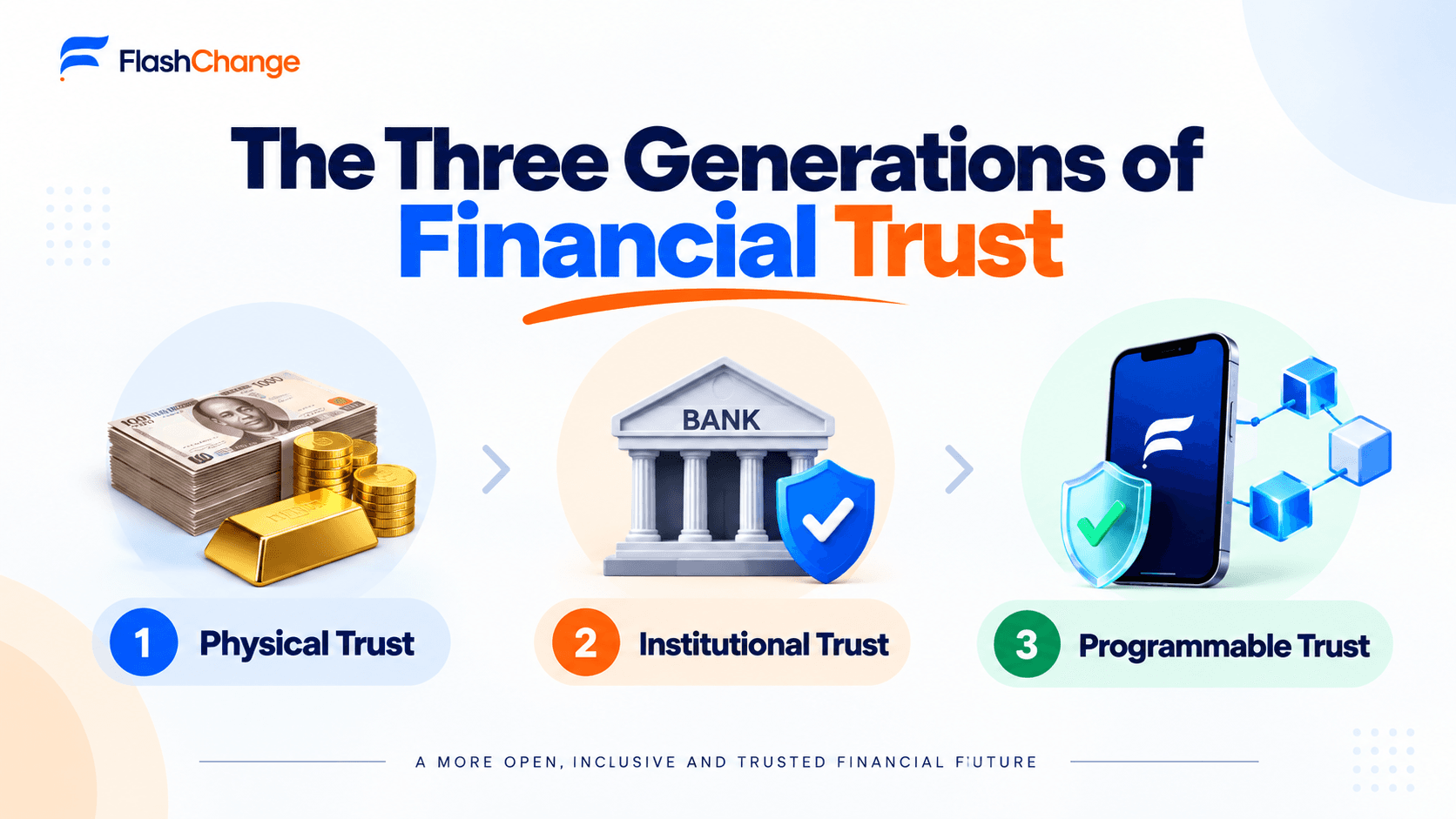
One useful way to see this shift: not as a move from cash to digital payments, but as three generations of financial trust, each one built on a different foundation for why people believed a transaction was safe.
FlashChange CEO Bidemi Oke has framed it this way, and it's a genuinely useful lens for understanding where finance is actually headed, not just what it looks like on the surface.
Physical Trust
The first generation tied trust to something tangible: gold, paper currency, a handwritten signature, a face-to-face handshake. Confidence came from what a person could physically see, hold, or verify with their own eyes.
This worked well at small scale, between people who could actually meet and check each other's word directly. It broke down the moment an economy needed strangers, who would never meet, to trust each other with real value. That gap is exactly what the next generation had to close.
Institutional Trust
As economies grew beyond what personal relationships could support, institutions stepped in as guarantors. Banks verified identities. Regulators authenticated currencies. Payment networks validated transactions. Every exchange ran through an intermediary whose entire job was reassuring two parties that the system could be trusted.
This is the generation most of today's financial system still runs on. It scaled trust far beyond what physical verification ever could, letting a person in Lagos trust a transaction with someone they'd never meet in London or Nairobi, because a bank or network stood behind it.
It also came with a cost: every transaction now depended on intermediaries, each adding friction, fees, and delay to what should, in principle, be a simple exchange of value.
Programmable Trust
We're now entering the third generation, and it's the one most digital finance conversations miss entirely.
Here, trust gets built directly into the technology itself rather than added afterward by an institution. Identities verify automatically. Transactions authenticate within seconds. Smart contracts execute agreements the moment predefined conditions are met. Artificial intelligence flags suspicious activity before a human ever reviews it.
The distinction sounds subtle, but it isn't. In the institutional generation, people trusted organizations that stood behind a system. In this generation, people increasingly trust the system itself, because reliability is engineered into it directly rather than promised by whoever operates it.
That shift, from trusting an institution's word to trusting a system's design, is what's actually reshaping finance right now. Everything else, the wallets, the apps, the interfaces, is just the visible surface of that deeper change.
Programmable Trust in Action: What It Looks Like in Africa Right Now
This isn't theoretical. Africa has one of the clearest working examples of programmable trust operating at scale right now: the Pan-African Payment and Settlement System, or PAPSS.
Launched by Afreximbank in partnership with the African Union and the AfCFTA Secretariat, PAPSS lets African businesses settle cross-border payments directly in local currencies, without routing every transaction through the US dollar first. As of early 2026, it connects more than 19 central banks and over 150 commercial banks across the continent.
What makes it a genuine example of programmable trust, rather than just a faster payment rail, is what's built into the system itself. PAPSS uses the ISO 20022 global messaging standard so different banks' systems can actually understand each other, and it runs AI-powered fraud detection and validation checks on every payment instruction automatically, before a human ever needs to intervene.
The results are concrete. Settlement times that used to take three to five days now average around seven seconds. Transaction volume processed through the system surged by more than 1,000% in 2026 compared to the year before, as more banks and central banks joined the network.
This is what Bidemi Oke's framework looks like once it leaves the conceptual stage. Nobody using PAPSS to settle a payment between Lagos and Nairobi is manually verifying trust the way a correspondent banking relationship once required. The trust is already built into the rails, the standards, and the automated checks running underneath the transaction. That's programmable trust, operating at continental scale, not as a prediction about the future, but as infrastructure already moving real money today.
Why Digitizing a Process Isn't the Same as Redesigning Trust
It's worth being precise here, because this distinction gets lost constantly.
Many organizations still measure digital transformation by counting how many services have moved online. Converting a paper form into an app is progress, but it isn't the same thing as redesigning how trust flows through a system.
This explains a pattern that shows up across several fast-digitizing economies: millions of digital transactions happening every day, and still real friction, inefficiency, and limited financial inclusion underneath it all. The missing ingredient is rarely another payment app. It's more often interoperable infrastructure, trusted digital identity, and regulation consistent enough for systems to actually work together instead of operating as isolated islands.
A country can have a dozen well-designed fintech apps and still lack a coherent financial ecosystem, if none of those apps' underlying trust and verification systems can talk to each other. The future of finance won't be decided by whoever builds the fastest app. It'll be decided by whoever builds the most trusted, interoperable ecosystem underneath all of them.
What This Means for Africa's Next Opportunity
Africa has already earned real recognition for accelerating digital financial adoption. According to the 3i Africa Summit in 2026, roughly 49% of adults in Sub-Saharan Africa now hold some form of digital financial account, a genuinely significant shift in a relatively short period.
But adoption alone isn't the finish line. The next opportunity extends beyond growing transaction volume. It's designing infrastructure where payments, identity, data, compliance, and commerce interact intelligently instead of existing as separate, disconnected systems.
This isn't just FlashChange's read on where things are headed. At GITEX Africa 2026, Wave Digital Finance made a strikingly similar point publicly: the future of money in Africa isn't only about moving transactions from cash to digital, it's about building infrastructure that's intuitive, resilient, and designed around how people and businesses actually operate, not imported wholesale from systems built for other markets.
That's a useful signal. When two different organizations, working on different parts of the same problem, independently arrive at the same conclusion, it's a reasonable sign the conclusion is actually correct rather than just a convenient narrative for either of them.
The Risks and Limits of Programmable Trust
None of this is unambiguously good news, and it's worth being honest about the limits.
Automated systems can encode bias or error at a scale no individual bank clerk ever could. A flawed fraud-detection model doesn't just make one mistake, it can make the same mistake against thousands of transactions before anyone notices the pattern.
Interoperability also requires real political and institutional coordination, not just good technology. PAPSS works because dozens of central banks agreed to participate; that kind of coordination is genuinely hard to achieve and easy to underestimate.
There's also a concentration risk worth naming. As trust infrastructure consolidates into a small number of major systems, whether payment rails, identity platforms, or verification networks, those systems become critical infrastructure themselves. A single point of failure in a widely-adopted trust system creates a much bigger problem than a single bank's outage ever did.
The Best Technology Disappears
Here's the part that sounds counterintuitive: the more advanced finance becomes, the less visible it's likely to be.
Almost nobody thinks about the internet protocols powering a video call, or the cloud infrastructure behind an online purchase. Future generations may feel the same way about payment rails, settlement networks, and blockchain architecture. Financial experiences will simply happen, securely and almost instantly, without anyone consciously noticing the trust infrastructure underneath.
That's not a sign these systems have become less important. History suggests the opposite: technologies tend to disappear from our attention precisely because they've become reliable enough that we stop needing to think about them at all. Programmable trust succeeding might look, paradoxically, like nobody talking about it anymore.
What This Means for Crypto and Fintech Brands
For crypto and fintech platforms, this points toward a clear priority. Trust that's built into how a system actually operates, its verification, its settlement, its response when something breaks, will outlast trust that's only built into marketing.
That's the same idea running through the other pieces in this series: why we argued Nigeria's path to becoming a genuine crypto hub depends on more than adoption, and why we argued communication, not technology, is what's actually holding back crypto trust in Nigeria today. Infrastructure, communication, and trust aren't three separate problems. They're the same problem, viewed from different angles.
The platforms that internalize that now are the ones positioned for what comes next, FlashChange included.
Conclusion
So, is finance becoming fully digital? That might not be the most useful question anymore.
A better one: are we entering an economy where trust itself becomes digital infrastructure? Because if that's true, the organizations shaping the future of finance aren't just moving money more efficiently from one place to another.
They're redesigning how entire economies create confidence at scale, automatically, invisibly, and increasingly without the intermediaries that used to be required for two strangers to trust each other at all.
That may turn out to be the more significant innovation, more significant than any single app, wallet, or currency built on top of it. Money was never really the point. Trust always was. It's just becoming something you can build directly into a system, rather than something you have to ask an institution to vouch for.
Related articles

Crypto
Why Crypto Still Struggles to Earn Trust in Nigeria
The real reason many Nigerians still don't trust crypto is not volatility and regulation. Find out why
Ememobong Udofot
Sep 17, 2026
•
3 min read

Crypto
How to Tell If a Fintech App Is Actually Trustworthy
Here's the actual checklist on how to know if a fintech app is legit from one that just looks trustworthy.
Ememobong Udofot
Sep 11, 2026
•
3 min read
Crypto
Can Nigeria Become Africa's Crypto Hub? What the Data Says
Can Nigeria Become Africa's Crypto Hub in capital or infrastructure? Here's what the data says and what's still missing.
Ememobong Udofot
Sep 11, 2026
•
3 min read
Subscribe to our Newsletter
Enter your contact details to get the latest news and trends to help boost your business.