Crypto
Why Crypto Still Struggles to Earn Trust in Nigeria
Sep 17, 2026
•
3 mins read

Ask why crypto still struggles for trust in Nigeria, and you'll get the same three answers every time. It's too volatile. The regulation is still unsettled. The infrastructure isn't there yet.
All three are real. None of them are the whole story.
Plenty of platforms are reasonably stable, reasonably compliant, and reasonably well-built, and users still hesitate to trust them with real money. The actual gap sits somewhere else: in how these platforms communicate, especially when something goes wrong.
The Usual Suspects Don't Explain the Real Problem
Volatility is real, and it matters. So is Nigeria's regulatory picture, still mid-build as of 2026, with the SEC finalizing digital asset rules a full three years after the Central Bank's initial restrictions.
But volatility and regulation are conditions an industry operates under. They're not, on their own, why a specific user decides not to trust a specific platform.
Consider the alternative: a platform can be fully licensed, technically secure, and operating in a stable regulatory lane, and still lose users the moment something goes wrong, simply because of how it handles that moment.
That's not a volatility problem. It's not a regulation problem either. It's a communication problem, and it's the one explanation that rarely makes the standard list.
It's also the harder one to fix. Volatility and regulation are largely outside any single platform's control. Communication isn't. Every platform decides, every day, how much it tells users and how honestly it does it.
Adoption Was Never the Problem
If the barrier were really about access or awareness, Nigeria wouldn't be leading Sub-Saharan Africa in crypto usage. But it is.
Nigeria's on-chain transaction value hit $92.1 billion between July 2024 and June 2025, according to Chainalysis, nearly three times South Africa's total and the highest in the region by a wide margin.
People are already using crypto, at real scale. That's worth sitting with, because it rules out the simplest explanation. This isn't a story about Nigerians being unfamiliar with digital assets or slow to adopt new technology.
It's a story about people using something at scale while still not fully trusting it, which is a stranger, more specific problem than low adoption would be.
The Trust Paradox: Even Nigeria's Own Digital Currency Isn't Trusted
Here's the clearest evidence that this is a trust problem, not a technology problem.
Nigeria launched the eNaira, Africa's first central bank digital currency, in October 2021. It's backed directly by the Central Bank of Nigeria.
Research from Gabriel Bizama at the University of Bern surveyed 1,000 Nigerian adults and merchants and found something counterintuitive: the eNaira ranks last in trust among Nigerians, behind cash and behind ordinary commercial bank deposits, despite being the one form of money with the most institutional backing of all.
If a currency backed directly by Nigeria's central bank still ranks last in trust, the problem was never really about who's holding the technology. It's about whether people believe what they're being told about it.
Bidemi Oke, Founder & CEO, FlashChange
That's the trust paradox in one data point: the most institutionally secure digital money in the country is the least trusted. Technology and backing didn't solve it. Communication might have.
What Happens When Communication Fails: The Patricia Case
Nigeria's crypto industry has its own case study in exactly this failure, and it's worth walking through in detail.
In early 2023, Patricia Technologies, a Nigerian crypto and gift card trading platform, suffered a security breach that compromised roughly $2 million in Bitcoin and naira assets. Security breaches happen across the industry. What happened next is the part that actually damaged trust.
Patricia's public statement described the situation as the company "undergoing internal restructuring" rather than giving users a clear account of what had happened. Withdrawals were suspended with no firm timeline. Many users first learned real details not from the company directly, but from other users complaining on Twitter.
Months passed. The company later converted affected users' crypto balances into a proprietary token, without the kind of full transparency that might have preserved user confidence through the process. Eventually, Nigerian police announced an arrest connected to the breach, tied to funds laundered through the incident.
None of this means the breach itself was avoidable, security incidents happen to serious platforms too. The damage came from what happened after: vague language standing in for real explanation, silence where updates should have been, and a resolution process users learned about piecemeal rather than upfront.
This is the pattern worth noticing. The technical failure was contained to one platform and one incident. The trust damage spread further, into how users across the broader Nigerian crypto space think about the industry generally. That's what unclear communication costs: not just the company that mishandles a crisis, but some of the trust every other platform in the category depends on too.
The 3 C's of Crypto Trust
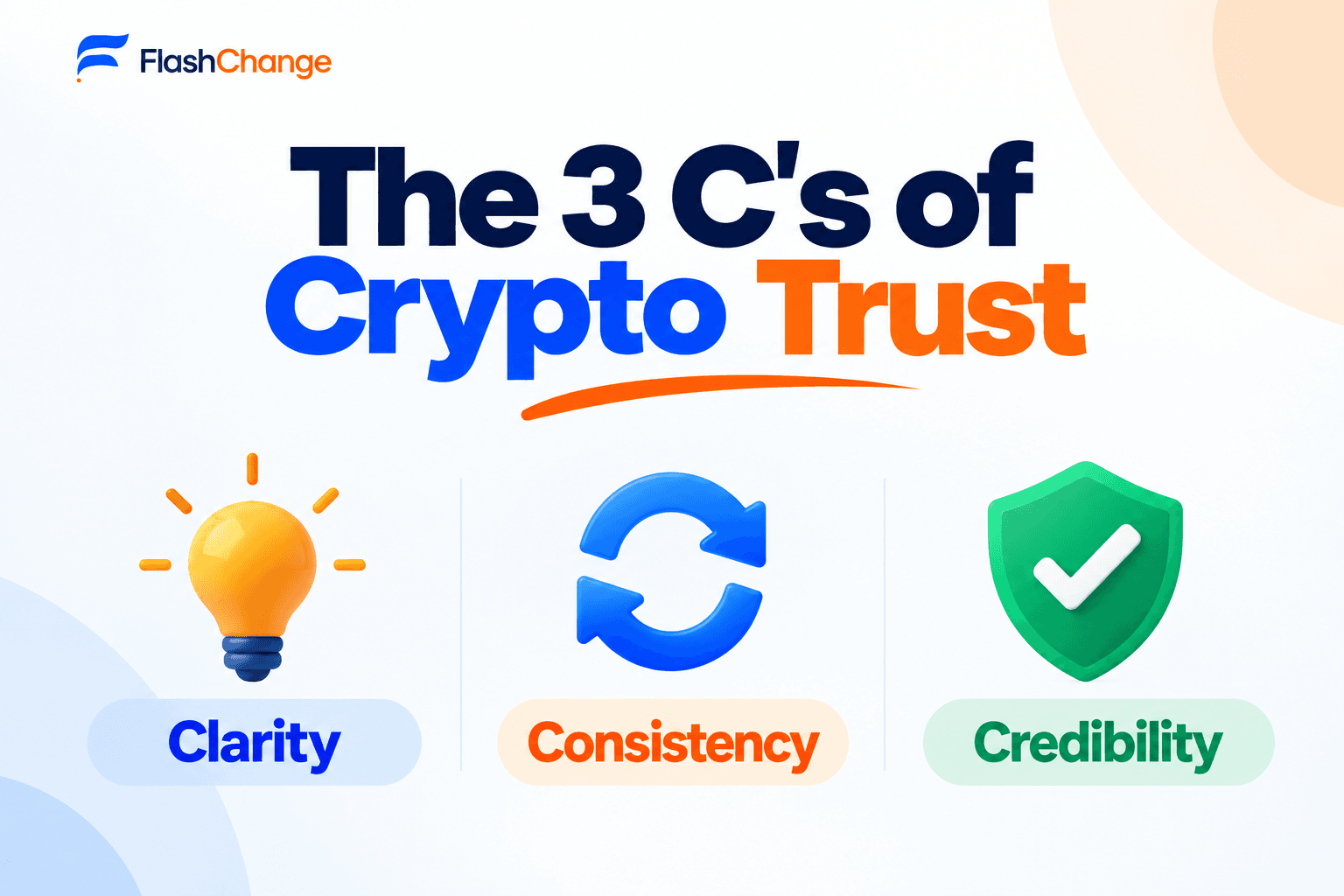
If unclear communication is the actual gap, then closing it isn't complicated, even if it's not easy. Three principles cover most of it: Clarity, Consistency, and Credibility. Treat them as a working framework, not just three adjectives that sound good in a mission statement.
Clarity
The industry's instinct has long been to produce more content: more explainers, more threads, more guides promising to finally make crypto make sense. The volume hasn't matched the actual clarity.
The industry's biggest challenge was never that we don't communicate enough. It's that we communicate too much, without enough context for people to know where to actually start.
Ememobong Udofot, Head of Branding & Communications, FlashChange
The job isn't to explain everything. It's to give someone enough context to confidently take the next step, whatever stage they're at. A platform that can answer "what does this mean for me?" in one sentence has done more for trust than ten well-produced explainer videos that leave the reader further along in knowledge but no clearer on what to actually do.
Consistency
A brand needs to sound the same whether someone's reading an app notification, a support reply, a social media post, or an investor update. Inconsistency is where users start filling in gaps with their own assumptions, usually the worst-case ones.
This is exactly where Patricia's response broke down. "Undergoing internal restructuring" on one channel, silence on withdrawals, and user-sourced information filling the rest. Three different stories, effectively, none of them the real one.
Consistency doesn't mean saying the same three sentences everywhere. It means the underlying facts, timeline, and tone hold together no matter which channel a user happens to be looking at when they go looking for answers.
Credibility
Credibility isn't claimed in a mission statement. It's earned, specifically, in the moments when something has gone wrong and a platform has to choose between a real explanation and a comfortable one.
Financial platforms don't get graded on whether problems happen. Problems happen everywhere, including at banks that have operated for a century. They get graded on what happens in the hours and days after, whether the response is honest and specific, or vague and defensive.
Every crisis is, in that sense, a credibility test a platform either passes or fails in public. The ones that pass tend to keep their users. The ones that don't tend to lose more than the money involved in the incident itself.
Why Unclear Communication Invites Bad Regulation
There's a cost to unclear communication that goes beyond individual user trust, and it lands on the whole industry.
When crypto brands fail to explain themselves clearly, someone else ends up doing the explaining instead, usually a regulator working from incomplete information, under pressure, on a tight timeline. Nigeria's own regulatory path shows what that looks like: a 2021 Central Bank restriction that shut banks out of the crypto industry almost entirely, followed by years of rebuilding toward the more structured framework the SEC has been finalizing since the Investments and Securities Act of 2025.
Misunderstanding doesn't just create stricter rules. It creates rules built to solve the wrong problem, because the people writing them were working from fragmented information instead of a clear account from the industry itself.
Explaining the industry clearly isn't just a trust exercise aimed at users. It's part of how the industry gets regulated sensibly instead of reactively.
What Good Crisis Communication Actually Looks Like
Set the Patricia timeline against what a stronger response looks like, and the difference is entirely about communication discipline, not technical capability.
Acknowledge the issue immediately, even before every detail is confirmed. Users can handle "we know something's wrong and we're investigating" far better than they can handle silence.
Give a real explanation, not a euphemism. "Internal restructuring" tells a user nothing. "We identified unauthorized access to a specific system on this date, here's what we know so far" tells them everything they actually need.
Provide a realistic timeline, and update it if it changes. A wrong estimate handled honestly costs less trust than a vague promise that quietly slips for months.
Avoid corporate jargon at the exact moment users are most anxious. This is when plain language matters most, not least.
None of this requires perfect execution. Financial platforms aren't expected to be flawless, they're expected to be honest about the moments when they aren't. That distinction is the entire difference between a crisis that costs a platform some trust and one that costs it the business.
Run Patricia's actual response against this list and the gap is obvious. No immediate acknowledgment beyond a vague statement. A euphemism standing in for an explanation. No firm timeline, then a long silence. That's not a hypothetical comparison. It's the difference between the response Nigerian crypto users actually got and the one that would have preserved their trust.
What This Means for Crypto and Fintech Brands
Trust doesn't get built in a mission statement or a campaign. It gets built, or lost, in specific moments: a delayed withdrawal, a vague update, a support reply that either sounds human or sounds like a script.
That's a standard worth holding any platform to, FlashChange included. It's also the same idea behind the checklist we laid out for evaluating any fintech app's trustworthiness: licensing and security matter, but so does what a platform actually says and does when something doesn't go to plan.
The brands that will earn lasting trust in Nigeria's crypto space won't necessarily be the ones with the fewest problems. They'll be the ones who communicate like they understand what's actually at stake when something goes wrong.
Conclusion
The honest answer to why crypto still struggles for trust in Nigeria isn't volatility, and it isn't regulation, even though both are real and both matter.
It's that too many platforms still communicate like the money moving through their systems isn't quite real, right up until a crisis forces them to prove otherwise, usually badly.
Nigeria's own digital currency, backed by its own central bank, still ranks last in trust. A well-known platform lost more in reputation than it lost in the breach itself. Neither outcome was decided by technology. Both were decided by communication.
If you're handling people's value, their savings, their transfers, you're not just running a platform. You're a financial institution in the public mind, whether you've built the communication discipline of one yet or not.
Related articles
Crypto
The Future of Digital Finance
Digital finance is now about trust moving from institutions into infrastructure itself, and Africa is where that shift is happening fastest.
Ememobong Udofot
Sep 17, 2026
•
3 min read

Crypto
How to Tell If a Fintech App Is Actually Trustworthy
Here's the actual checklist on how to know if a fintech app is legit from one that just looks trustworthy.
Ememobong Udofot
Sep 11, 2026
•
3 min read

Crypto
Can Nigeria Become Africa's Crypto Hub? What the Data Says
Can Nigeria Become Africa's Crypto Hub in capital or infrastructure? Here's what the data says and what's still missing.
Ememobong Udofot
Sep 11, 2026
•
3 min read
Subscribe to our Newsletter
Enter your contact details to get the latest news and trends to help boost your business.